Tissue culture is the cultivation of plant cells, tissues, or organs on specially formulated nutrient media. Under the right conditions, an entire plant can be regenerated from a single cell. Plant tissue culture is a technique that has been around for more than 30 years. Tissue culture is seen as an important technology for developing countries for the production of disease-free, high quality planting material and the rapid production of many uniform plants. | 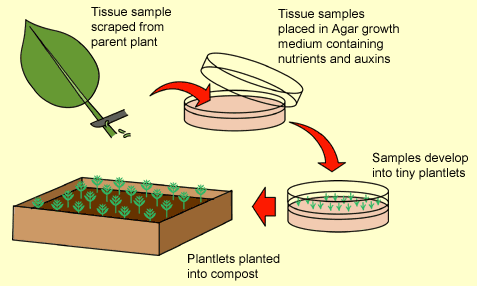 |
Micro propagation, which is a form of tissue culture, increases the amount of planting material to facilitate distribution and large scale planting. In this way, thousands of copies of a plant can be produced in a short time. Micro propagated plants are observed to establish more quickly, grow more vigorously and taller, have a shorter and more uniform production cycle, and produce higher yields than conventional propagules.
Plant tissue culture is a straightforward technique and many developing countries have already mastered it.Its application only requires a sterile workplace, nursery, and green house, and trained manpower. Unfortunately, tissue culture is labor intensive, time consuming, and can be costly. Plants important to developing countries that have been grown in tissue culture are oil palm, plantain, pine, banana, date, eggplant, jojoba, pineapple, rubber tree, cassava, yam, sweet potato, and tomato.
Tissue culture technology has made it possible for farmers to have access to the following:
- large quantities of superior clean planting material that are early maturing (12-16 months compared to the conventional banana of 2-3 years)
- bigger bunch weights (30-45 kg compared to the 10-15 kg from conventional material)
- higher annual yield per unit of land (40-60 tons per hectare against 15-20 tons previously realized with conventional material)
Moreover, uniformity in orchard establishment and simultaneous plantation development has made marketing easier to coordinate with the possibility of transforming banana growing from merely subsistence to a commercial enterprise. An encouraging finding from a cost-benefit analysis of the project is that tc banana production is more remunerative as an enterprise than traditional banana production.
