The term genetic engineering, often interchanged with terms such as gene technology, genetic modification, or gene manipulation, is used to describe the process by which the genetic makeup of an organism can be altered using “recombinant DNA technology.” This involves using laboratory tools to insert, alter, or cut out pieces of DNA that contain one or more genes of interest. The ability to manipulate individual genes and to transfer genes between species that would not readily interbreed is what distinguishes genetic engineering from traditional plant breeding.
Nature’s own genetic engineer:
The “sharing” of DNA among living forms is well documented as a natural phenomenon. For thousands of years, genes have moved from one organism to another. For example, Agrobacterium tumefaciens, a soil bacterium known as ‘nature’s own genetic engineer’, has the natural ability to genetically engineer plants. It causes crown gall disease of a wide range of broad-leaved plants, such as apple, pear, peach, cherry, almond, raspberry and roses. The disease gains its name from the large tumor-like swellings (galls) that typically occur at the crown of the plant, just above soil level. Basically, the bacterium transfers part of its DNA to the plant, and this DNA integrates into the plant’s genome, causing the production of tumors and associated changes in plant metabolism.
Application of genetic engineering in crop production Genetic engineering techniques are only used when all other techniques have been exhausted, i.e. when the trait to be introduced is not present in the germplasm of the crop; the trait is very difficult to improve by conventional breeding methods; and when it will take a very long time to introduce and/or improve such trait in the crop by conventional breeding methods. Modern plant breeding is a multi-disciplinary and coordinated process where a large number of tools and elements of conventional breeding techniques, bioinformatics, molecular genetics, molecular biology and genetic engineering are utilized and integrated.
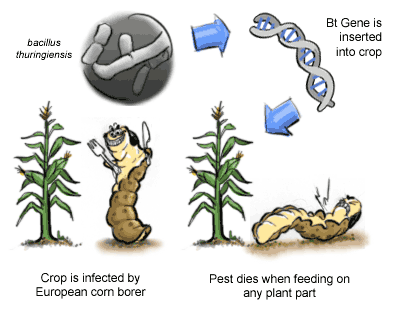 | 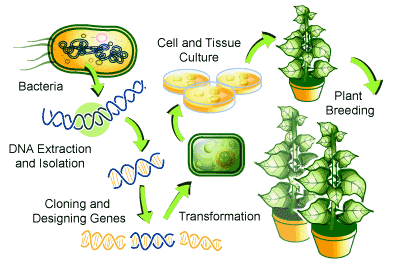 |
The process of genetic engineering requires
the successful completion of a series of five steps:
Step 1. Nucleic acid (DNA/RNA) Extraction:
Nucleic acid extraction, either DNA or RNA, is the first step in the genetic engineering process. It is therefore important that reliable methods are available for isolating these components from the cell. In any isolation procedure, the initial step is the disruption of the desired organism, which may be viral, bacterial or plant cells, in order to extract the nucleic acid. After a series of chemical and biochemical steps, the extracted nucleic acid can be precipitated to form a thread-like pellets referring to the DNA/RNA.
Step 2. Gene cloning:
The second step in the genetic engineering process is gene cloning. Upon DNA extraction, all DNA from the desired organism is extracted at once. Through gene cloning, the desired gene/s can be isolated from the rest of the DNA extracted, which is then mass-produced in a host cell to make thousands of copies of the desired gene. There are basically four stages in any cloning experiment involving generation of DNA fragments, joining to a vector, propagation in a host cell, and selection of the required sequence.
Step 3. Gene Design and Packaging:
Once the gene of interest has been cloned, it has to be linked to pieces of DNA that will control how the gene of interest will work once it is inside the plant genome. These pieces of DNA will switch on (promoter) and off the expression of the gene inserted. Gene designing/packaging is done by replacing an existing promoter with a new one and incorporating a selectable marker gene. Promoters allow differential expression of genes. For instance some promoters cause the genes inserted to be expressed all the time, whereas others allow expression only at certain stages of plant growth, in certain plant tissues, or in response to external environmental signals. The amount of the gene product to be expressed is also controlled by the promoter. Some promoters are weak, whereas others are strong. Controlling the gene expression is an advantage. Selectable marker genes are also usually linked to the gene of interest to facilitate its detection once inside the plant tissues. This enables to select the cells that have been successfully incorporated with the gene of interest, thus saving considerable expense and effort. Currently, genetic engineers use antibiotic resistance marker gene to screen plant tissues with the insert. Those cells that survive the addition of antibiotics to the growth medium indicate the presence of the inserted gene. Because of some concern that the use of antibiotic resistance marker genes will increase antibiotic resistance in humans and animals, genes coding for resistance to non-medically important antibiotics are preferred. In addition, alternative types of marker genes are being developed. Once the gene of interest is packaged together with the promoter and the marker gene, it is then inserted into a bacterium to allow for the creation of many copies of the gene package.
Step 4. Transformation:
Once the gene package is ready, it can then be introduced into the cells of plant being modified through the process called transformation or gene insertion. The most common methods used to introduce the gene package into the plant cells include bio listic transformation using the gene gun or Agrobacterium-mediated transformation. The main goal in any transformation procedure is to introduce the gene of interest into the nucleus of the cell without affecting the cell’s ability to survive. If the introduced gene is functional, and the gene product is synthesized, then the plant is said to be transformed. Once the gene inserted is stable, inherited and expressed in subsequent generations, then the plant is considered a transgenic.
Step 5. Backcross Breeding:
Backcross breeding is the final step in producing genetically engineered crops. This is done by crossing the transgenic plant with elite lines using conventional plant breeding methods. This enables the combination of the desired traits of the elite parents and the transgenic into a single line. The offspring are repeatedly crossed back to the elite line to obtain a high yielding transgenic line. The length of time in developing transgenic plant depends upon the gene, crop species, available resources and regulatory approval. It varies from 6 to 15 years before a new transgenic hybrid is ready for commercial release.
