|  |
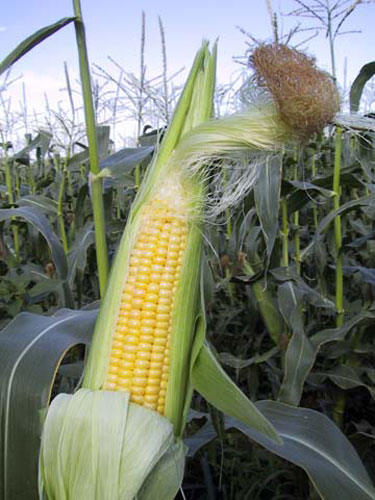
Since the beginning of agriculture eight to ten thousand years ago, farmers have been altering the genetic makeup of the crops they grow. Early farmers selected the best looking plants and seeds and saved them to plant for the next year. Then once the science of genetics became better understood, plant breeders used what they knew about the genes of a plant to select for specific desirable traits to develop improved varieties. The selection for features such as faster growth, higher yields, pest and disease resistance, larger seeds, or sweeter fruits has dramatically changed domesticated plant species compared to their wild relatives. For example, when corn was first grown in North and South America thousands of years ago, the corn cobs farmers harvested were smaller than one’s little finger. Today, there are hundreds of varieties of corn, some of which produce cobs as long as one’s forearm.
Mutation breeding:
In the late 1920s, researchers discovered that they could greatly increase the number of these variations or mutations by exposing plants to X-rays and chemicals. “Mutation breeding” accelerated after World War II, when the techniques of the nuclear age became widely available. Plants were exposed to gamma rays, protons, neutrons, alpha particles, and beta particles to see if these would induce useful mutations. Chemicals, too, such as sodium azide and ethyl methanesulphonate, were used to cause mutations. Mutation breeding efforts continue around the world today. Of the 2,252 officially released mutation breeding varieties, 1,019 or almost half have been released during the last 15 years.
Examples of plants that were produced via mutation breeding include wheat, barley,rice, potatoes, soybeans, and onions.
Hybrid seed technology:
The end result of plant breeding is either an open-pollinated (OP) variety or an F1 (first filial generation) hybrid variety. OP varieties, when maintained and produced properly, retain the same characteristics when multiplied. The only technique used with OP varieties is selection of the seed-bearing plants.Hybrid seeds are an improvement over open pollinated seeds in terms of qualities such as yield, resistance to pests and diseases, and time to maturity. Hybrid seeds are developed by the hybridization or crossing of parent lines that are ‘pure lines’ produced through inbreeding. Pure lines are plants that “breed true” or produce sexual offspring that closely resemble their parents. By crossing pure lines, a uniform population of F1 hybrid seed can be produced with predictable characteristics.
