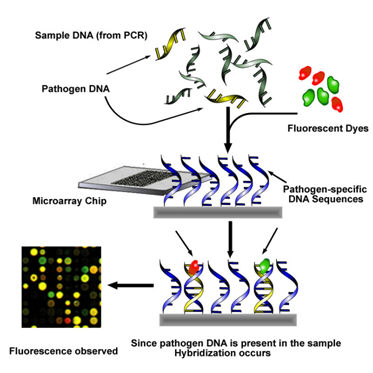
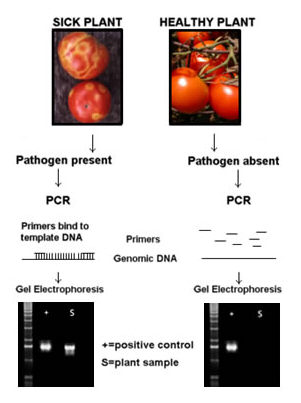
Biotechnology has also allowed the development of diagnostics which has assisted farmers worldwide in managing different diseases affecting their crops. New diagnostic techniques are now available that require minimal processing time and are more accurate in identifying pathogens. These diagnostics are based on rapid detection of proteins or DNA that are specific to each pathogen, disease or condition. Some procedures require laboratory equipment and training, while other procedures can be performed on site by a person with no special training.
 |  |
Examples of existing diagnostic
techniques:
ELISA diagnostic kits ;
ELISA (enzyme-linked immunosorbent assay) kits are based on the ability of an antibody to recognize a certain protein substance or antigen associated with a plant pathogen. The kits are very easy to use; some tests can be used in the field where a disease is suspected and can take only 5 minutes to perform. In addition, they do not require sophisticated laboratory equipment or training.
There are already numerous ELISA test kits available in the market to detect diseases of root crops (e.g. cassava, beet, potato), ornamentals (e.g. lilies, orchids), fruits (e.g. banana, apple, grapes), grains (e.g. wheat, rice), and vegetables. For example, these techniques can detect ratoon stunting disease of sugarcane, tomato mosaic virus, papaya ring spot virus, banana bract mosaic virus, banana bunchy top virus, and watermelon mosaic virus.
Direct tissue blotting:
This technique also utilizes specific antibodies to detect the presence of plant pathogens. In this method, diseased tissue samples are pressed to draw out proteins onto a special paper and the antibodies are added to the sample. A color-inducing reagent is added afterwards to react with the antibody-pathogen complex. Color reaction indicates a positive result and pinpoints the location of the pathogen in the diseased tissue. DNA/RNA probes Another set of tools that can be used in plant disease diagnostics is nucleic acid (DNA/RNA) probes. These probes are fragments of nucleic acid arranged in a sequence complementary to that of the DNA or RNA of the pathogen. Because the sequences complement each other, the probes can be used to identify specific diseases.
Squash blot method :
In the squash blot method, tissue from a plant that is suspected to be diseased is “squashed” onto a special piece of paper, called a membrane. This membrane is then treated with a probe that can bind with the DNA or RNA of the plant pathogen suspected to be in the tissue. Binding will occur when complementary sequences are present. After adding several more substances to the membrane, a color reaction indicates that the probe and the pathogen DNA/RNA have bound to each other and the disease is present. No color reaction means the test for the disease is negative.
PCR:
Polymerase Chain Reaction (PCR) also uses nucleic acid probes to detect the presence of a pathogen. This is a lot more sensitive compared to the other techniques as PCR can detect very small amounts of a pathogen’s genetic material per sample and amplify certain sequences to a detectable level. PCR can be used to detect the presence of pathogens in the air, soil, and water. Spores, especially those produced by fungi, are the primary source of infection to initiate epidemics. This can greatly help farmers in predicting possible diseases and the extent of the damage it can bring. It can also help farmers detect the presence of pathogens that have long latent periods between infection and symptom development. Farmers can therefore keep track of the pathogen and apply the necessary control to prevent the spread of the disease. PCR can also be used to detect if mutations are occurring in a given population of pathogens. These genetic mutations lead to the development of resistant strains. The development of molecular test kits can be expensive but the returns are great. Further, they have short commercial timeframes, few regulatory barriers (because they are not consumed), and can be marketed widely, including directly to farmers.
